Saturday, September 27, 2008

Browsing


The good thing about blogs is that there are no editors around.  Editors are the natural enemies of writers.  Magazine editors are the worst of the lot because they have a space constraint in addition to their natural instinct to "improve" the piece.

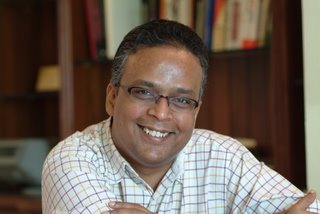
Anyway, Business World magazine asked me to write about books I was reading and, in general, about my reading habits.  My responses are given below.  They then published an "edited" version that is shown in the picture alongside.  You judge whether the editor did a good job.

Q: Which book are you reading at the moment and why did you pick it up? 

A: I am reading “The last lecture” by Randy Pausch.  I watched the video of the lecture just after Randy Pausch died.  I found the lecture absolutely fascinating.  I have therefore bought the book to read in greater detail.

Q: What you have learned so far from the book? 

A: Fascinating book about the values that helped him achieve his childhood dreams.  These are the lessons that he wants to tell his children about, but had no other way of communicating since the author was dying of cancer.  I find such books inspiring and uplifting.

Q: Is it the kind of book you normally read? If not, what is your preferred reading (fiction, management, self-help, spiritual etc)? 

A: I normally read non fiction books that cover a wide range of topics from physics to philosophy, from Indian culture to management, from biographies to humour.  I firmly believe in the dictum that facts are stranger than fiction.  If you want to know more about the books I read or recommend, go to my blog (sumansrivastava.blogspot.com) and look at the “Favourite books” box on the left hand side.   I have a list of books that I have read with my ratings for them.  Among my all time favourites: 

May you be the mother of a hundred sons by Elisabeth Bumiller

What should I do with my life? By Po Bronson

The Razor’s Edge by Somerset Maugham

Q: How do you buy your books (based on reviews, browsing on the Net, favourite bookstore etc)? 

A: I buy books almost indiscriminately much to the despair of my wife.  I enter book stores whenever I can - there is a Crossword very close to my house in Bandra, and I also go into book shops in airports.  I buy whatever catches my fancy.  I also read a lot about books in magazines and hear podcasts about them.  One of my favourite book reviewers is NPR (National Public Radio).  I listen to their book reviews via podcasts.

Q: What are some of the other books on your reading list at the moment. 

A: I get nervous if my “to read” shelf at home is empty.  So I always keep it stocked.  Currently among the books bought and waiting to be read are:

Sea of Poppies by Amitav Ghosh

Billions of Entrepreneurs by Tarun Khanna

Myth = Mithya by Devdutt Pattanaik


Wednesday, September 24, 2008

Rap your way to knowledge

Education is getting more fun all the time.  My son is in an IB school and I marvel at the teaching techniques that they use. So much more interesting than the rote method that people of my generation had to ingest.

Here is a rap video about the new CERN collider.  A lot of nonsensical stuff has appeared in the media about this, but the video talks about what they are really looking for.  It is probably over simplified, but it is still not easy.  But turning it into a rap song may help the scientists connect with a lot more people in the younger generation than scholarly articles.

Enjoy.


Wednesday, September 03, 2008

The Last Lecture

I have been hugely impressed and inspired by "The Last Lecture" of Randy Pausch.  It is funny in parts, entertaining and educational.  I have seen the video and am currently reading the book.  If you haven't seen the entire lecture yet, please do see it here.

Randy died last month.  I wish I could talk as well as he does.


Tuesday, July 29, 2008

Resist the two year itch


I sound like a stuck record when I tell young people that frequent shifts in jobs may get short term gains, but is not a wise long term career strategy.  I point out as evidence the number of agency heads, creative heads and office heads who have been with their current agencies for a long time.  

Now there's a study done by a global research and analytics firm that supports my statement.  An article on this was published in today's Business Standard (click here) The study shows that across industries, senior executives look warily at people who change jobs too often.  It also shows that people who have changed jobs very quickly don't get sufficient training and other developmental inputs from their companies and hence suffer in the long term.  

I wonder if young people would heed advice such as this or just dismiss them as typical rants from old people.  I know that my own young relatives often look at me as a creature to be pitied rather than censored.  I am equally sure that saying "I told you so" is not going to improve my image.  

I guess the only way young people will learn is by making mistakes themselves.  It may well be too late.


Tuesday, July 15, 2008

Let's not talk ourselves into bad times

For the last few weeks the media is full of stories about the bad times coming to India.  There is data to show lower growth rates in many sectors, the stock market indices are going down, the real estate boom seems to have plateaued and there are features about how consumers are buying less than before.

I am not quite sure whether all this is media hype or a reality.  I have tended to think that it is hype.  When growth rates fall from 9% to 7.8% that is not a recession.  Especially when you consider that in a previous decade a growth rate of 7.8% would have been a huge cause for celebration.

Today, there is a comment from the Chairman of ICICI Bank, KV Kamath, which points out that it is too early to talk of a slowdown (click here).  I am so happy to see this statement - even though it is a little half hearted.

Slowdowns are about human sentiment and therefore if we all believe that there is a going to be bad times, then there will be.  The secret is to stay positive.  

Cheers

Saturday, June 28, 2008

Alternative. Entrepreneurial. Community service.


I just read about this IIMA graduate from Bihar who has gone back to his village in Nalanda to sell vegetables.  He has designed an ice-cooled pushcart in order to market them and hopes to do so across the country.  Read the whole article here.

Wow.  

Our studies at Euro RSCG India have been looking at some trends among Indian youth.  We keep talking about Indian youth looking for alternative career options.  We believe that Indians are entrepreneurial (jugaadu).  And we believe that today's youth wants to serve society if he can (Rang de basanti, Munnabhai).  

This one story highlights all the three trends.  Its the sweet spot of the three trends.

I was attracted to this story because it is so different, but also because of my IIMA and Bihar connections.  So that's another sweet spot!


Saturday, June 14, 2008

Indian are like a chest of drawers

Pawan Varma said that Indians were like a chest of drawers.  Different aspects of their personality are kept separate and do not conflict with each other.  What better way to prove this than this piece from The Economic Times.  Scientists offer prayers before they launch rockets.  If you think there is no contradiction in that, then Congratulate yourself.  You are still an Indian in spite of your education!

Here is the full Eco Times article.


Indian scientists secular, but firm believers in god
14 Jun, 2008, 1304 hrs IST, IANS

NEW DELHI: Indian scientists are very much secular but that doesn't go against their belief in god. A survey has found that many of them seek divine blessings before embarking on major scientific missions. 

The study, "Worldviews and Opinions of Scientists in India", carried out by the Trinity College of the US with help from Centre for Inquiry (CFI) India, a non-profit organisation, has found that 49 per cent of scientists believe prayer is "efficacious as therapy". 

Though most of the 1,100 Indian scientists surveyed described themselves as "secular", they refused to be called irreligious. The survey came out last week. 

"In 2005, space scientists went to Tirupati to seek the blessings of Lord Venkateswara before launching the rocket and satellite," the study reveals. 

It also found that only eight percent of the scientists said they would refuse to work on stem cell research because of moral or religious beliefs. 

Nearly 83 per cent of respondents described secularism as the "separation of religion from state and government" and 93 per cent termed it as "tolerance for religions and philosophies." Only 20 per cent considered that secularism means atheism. 

"Indians are by nature god believing people. They don't put spirituality versus science. Our ethos is broad - while we are rooted to our belief we are also open to new ideas, knowledge and innovations," renowned scientist Y.S. Rajan said. 

"There is broadly no conflict as we are for religious plurality. Let me be clear, there is no basic dichotomy between science and god," he added. 

The study found that a majority of scientists believe in the existence of god or "some higher power". Some even said that they don't know whether there is god or not. "The majority of scientists think they are spiritual," the study found. 

Placid Rodriguez, former director of Indira Gandhi Centre for Atomic Research, said religion or belief in god is a part of the Indian value system. "It's a part of our family value and social need." 

"I as a Christian have broken coconuts at the beginning of some programme (though it's a Hindu practice). God or religion is an inbuilt belief," Rodriguez, who is currently a Raja Raman Fellow and distinguished professor at IIT Madras, said over phone from Chennai. 

The study found nearly 75 per cent of these top scientists - whom the survey termed as "elite" - said they believe in the Hindu cycle of life. At least 29 per cent believe in karma, 26 per cent in life after birth and 20 percent in reincarnation. Similarly, 38 percent said god performs miracles. 

"I don't think, we can call the karma and rebirth theory unscientific. The belief helps us do good work and leads us towards ultimate equality. It's a beautiful imagination to improve yourself," Rajan explained. 

The study sampled participants from 130 universities and research institutes in India between July 2007 and January 2008. 

Barry A. Kosmin, the lead researcher of the study, said, India was chosen because of its increasing scientific and economic importance on the global scene." 

Family run businesses - A good perspective

I just read this very interesting article by T N Ninan in the Business Standard on the Ranbaxy deal.  I liked it so much, that I am reproducing it in full below.  Before you go, here is one thought from me:  Why is corporate India / Indian media so upset that a good Indian company has been bought by a foreigner?  Is that we can only dish it out (buy other's companies) and not take it?

Here is T N Ninan:

A friend commented that it must be nice for Malvinder Singh of Ranbaxy to pocket Rs 10,000 crore and also get nice things said about him by the media. Perhaps, but it is instructive to look at all the families that did not sell out when the going was good. Many of them are still in control of their companies and groups, but these are pale shadows of what they used to be at the height of their glory—and many of them live and work in the same city as the Ranbaxy chief executive. There are the Nandas, for instance: two brothers who have had their differences, who have parted ways, and whose companies are a far cry from their father's Escorts that Swraj Paul raided a quarter century ago because it was (among other things) the country's leading tractor manufacturer and also its leading motor-cycle company. Escorts no longer makes motor-cycles. It has got into a series of other businesses, none of which have done particularly well, and it finally resorted to converting a charitable trust (which ran the Escorts hospital) into a company in order to sell it and make some money.

There is the other company that Paul raided: DCM. The brothers who ran it had squabbled for years, and the company was split into many parts, some of which have done quite well and others have not; one even defaulted big-time on deposits taken from the public. The combined sum of the parts today is a far cry from the DCM that used to be the country's fourth or fifth largest company. At its core, the company's decline was a failure to recognise that all the members of the third generation were not equally endowed and therefore fit for business responsibility.

There is also the saga of the Modis, nine brothers and cousins who once moved ambitiously into an impressive array of businesses, most of which have fallen by the wayside. Modi Rubber used to be the king of the truck tyre business, Xerox was a Modi partner in India and so was Blue Circle, once the world's leading cement manufacturer. You don't hear much about the Modi businesses any more, other than for BK Modi wanting to sell his stake in Spice and Lalit Modi organizing cricket's Indian Premier League.

These Delhi examples can be multiplied in other parts of the country, almost ad infinitum. Ahmedabad's Sarabhais, for instance, were among the country's premier business families, so were Mumbai's Mafatlal and many of Kolkata's Marwari clans. None of this is to argue that there is something wrong with family-run businesses, because the evidence is that they often do better than the ‘professionally' managed companies. The issue therefore is to recognize that the interests of a business and those of its controlling family are not identical. Also, whose interests do you put first: that of the family, or of the business that has other stake-holders? If the operating principle is that all members of a family must be given an equal role in the business and that they will not make way for better managers who are not members of the family (in other words, the feudal principle), it is hard to see such a company prospering for long in a competitive market.

The vindication of Malvinder Singh's action is that the new owner of Ranbaxy wants him to continue as the chief executive. If all the businessmen who have presided over the decline of their companies had asked themselves whether they would be able to retain their corner suites even if the company passed into other hands, the history of Corporate India would have been different.


Thursday, June 12, 2008

Evolution of our business model

The biggest change in the communications industry over the next 4 years is going to be in our business model itself.  I think it is going to look very different from the way it is today.  In this piece, I shall examine the factors that are causing the change and the possible direction that the change may take. 

The biggest challenge facing the industry is getting good talent.  The challenge in getting good talent is that we are not paying them enough especially when you compare our pay scales with that in media, retail, IT and other sectors.  The reason we are not able to compete is because our clients have squeezed our margins.  Our margins will only improve if we add dramatically new value to clients.  So that is one set of factors that will force our business model to change.

The second set of factors relates to our client’s business needs.  Their business models have evolved rapidly as well and most marketers are faced with new challenges that do not have enough precedents.  So they need to have trusted advisors who will help them in navigating through these storms and air pockets.

The third set of factors relates to technology.   The internet, video conferencing technology, the mobile phone (including the Blackberry) and the laptop have dramatically changed the supply side of the industry.  The effects of all this on our industry is only just beginning.  In future, agencies will be able to have larger catchments than simply their own cities, regions or countries.  Also it will be easier and cheaper to set up agencies than ever before and so agencies will face greater competition than ever before.

To summarize, we have to increase our margins by adding value to clients.  Clients need more and better advice. And technology will change the scope of our markets as well as bring in new competition.

Clearly therefore agencies have to move from earning most of our revenue from execution to earning most of our money from consultancy and ideas.  This seems obvious, but I would like to outline some of the deeper issues involved.

As an industry we think we earn on the basis of ideas just because we may have moved from a commission based remuneration model to a fee based one.  But that is not true.  We still justify our fee based on the number of people and man-hours that we will spend on the business or on the basis of the output these people will create.  We never base it on the quality of our ideas.  How then are we really in the ideas business?

Our processes were created in an era where we earned commissions and we haven’t changed them after we moved to a fee based structure.  We still wait for client briefs and tend to be reactive.  Consultants are more self driven and work according to well defined deliverables and milestones.  We have yet to learn how to do that.

Also, while at a top management level, we talk about integration and 360 communications, we don’t actually walk the talk.  We still have divisions based on our specializations and each of them have business targets.  Thus their advice tends to be highly skewed towards their own disciplines.  This makes the client suspicious of our recommendations.

Given all this, here is what I think the business model of the future would be.

Agencies will organize themselves around industry verticals – rather like the practices that consultants have, rather than around their service offering.  Thus we will have divisions like retail, technology, healthcare, consumer goods, durables etc.  Each of these divisions will develop proprietary knowledge into their industries.  This knowledge will enable them to provide advice with confidence to their clients and actually command their respect.

Our remuneration will grow to much higher levels but will carry more risk.  We will no longer get assured fees at low levels, but high fees that are indexed to the outcomes for the client.  A kind of pay by results model that the internet has taught us. 

Agencies will then need to plan their portfolios well.  They will need some clients who will perform steadily with low risk, others who will perform brilliantly but with high risk.  Each agency will have to balance these types of clients according to their own risk appetites. 

Very few clients will be able to afford the integrated service model that agencies will offer.  Only the really large clients or clients in complex competitive situations will sign on as integrated clients.  Most clients will focus on specific areas where they need high quality help.  For every thing else, they will be able to access commoditized services off the net.  So in effect, our industry will evolve into two – a customized, high price model and a mass produced, low price one. 

I am really looking forward to the next few years as these changes unfold.  Advertising is still the activity where you can have the “most fun with your clothes on”.  Only now it is going to evolve into a slightly different kind of fun. 

Put your seat belts on.


Sunday, March 16, 2008

THE SECRET INDIA TODAY CONCLAVE


I have spent the last 2 and a half days at the India Today Conclave in Delhi. It was a superb event with lots of very interesting speakers. Unfortunately this conference not been covered widely in our media, because media groups do not allow coverage of each other's events. Its really petty when you think that the news media in India covers such inane news most of the time, and yet couldn't (or didn't) cover excellent speeches by a glittering array of speakers. So much so that just now when I searched for "India Today Conclave" on Google, it didn't show up any results! Of course, the India Today group does have very extensive coverage of the event - you can read the reports, watch the videos and look at the pictures by clicking here.

So in my own small way, I shall now fill the breach and tell the two and a half people who read my blog, all about the conclave. Or at least, the bits that impressed me the most.

Space tourism is here. We got to see a model of the plane that will launch the space vehicle, a model of the space vehicle, a video of the first test flight and an animation video of what it will be like when the space vehicle goes up with passengers. All this was presented to us by Stephen Attenborough, commercial director, Virgin Galactic. The most amazing bits about the space travel are the two breakthrough innovations that are going to make space travel cheaper and safer at the same time. One is the idea of launching the "rocket" from the air rather than the ground. It requires less energy and is safer because if something goes wrong, the rocket can simply glide down to earth. The second idea is to have rotating wings that turn to slow down the vehicle's re-entry into the atmosphere and ensures that it is not as stressful an event as it has been for the space shuttles. Difficult to explain in a few words, but you might like to go to
Virgin Galactic's site and watch the flash videos about the technology.

Sunil Mittal and Wim Elfrink, Chief Global Officer of Cisco, made excellent presentations on the future of communications. Not just about what technology is going to do, but how it will affect human beings. Sunil spoke about empowerment of people the mobile phone will be the identity card and the credit card for the poor. He also made a fervent appeal to not have any more regulators for his industry. Mr. Elfrink showed us the benefits of "Tele-presence" and how that would change the way we live and work.

Now that I have revealed my fascination for technology by opening this piece with the most techy bits, let me move on to the other people were fascinating.

Narendra Modi, Vikram Akula, Yasin Malik and Peter Roebuck were the speakers who made the biggest impression on me. That is saying something since the other speakers included Bill Clinton, Al Gore, L K Advani, Chidambaram, Mukesh Ambani, Adam Gilchrist, Amir Khan, Preity Zinta, Sachin Pilot, Farookh Abdullah, Digvijay Singh, Bishen Bedi, Ashok Amritraj and Craig Venter.

I must also mention in this context that some of the moderators were brilliant too. Aron Purie, Anand Mahindra, Shekhar Kapur and Prabhu Chawla excelled in this role. I have never seen such high quality moderation at any panel discussion before.

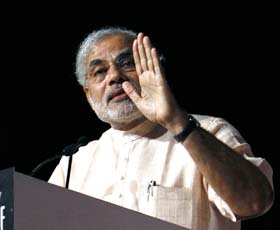
Narendra Modi & Yasin Malik (the Kashmir Liberation Front leader who is fighting for an independent Kashmir) were the two anti-heroes who came to the conclave. I think everyone was very curious about these two people and we were not disappointed. They both put forward their views in a very forceful and convincing manner. After the session where Mr Modi spoke, I asked many people who they would vote for between him, Digvijay Singh and Farooq Abdullah. Mr Modi was the clear people's choice.

I didn't dare do a similar exercise after Yasin Malik's speech. I did put my foot in my mouth by saying that I was impressed by him to a person who, I later discovered, was a Kashmiri Pandit. This gentleman was already seething and he just let me have it. He called Malik a murderer, a rapist and a terrorist and criticized the India Today people for having him at the conclave. He was not alone. A few people were demonstrating outside the hotel and one person actually entered the hall and shouted to have the event stopped. He was escorted out by the security people.

Mr. Al Gore’s speech was billed as the highlight of the conclave. The turnout for this absolutely amazing. Half the Indian cabinet (including Mr. Chidambaram) were present. All the speakers stayed on to listen to him – this included film stars like Preity Zinta and Amir Khan. All the industrialists came back from their meetings. (I even noticed Mr. & Mrs Adi Godrej, who seemed to have flown in from Bombay just for this.) The décor of the hall was changed to reflect the “green” look, and the who’s who of Delhi turned out in their most designer clothes.

In the end, the speech was a little disappointing. I guess it is tough to live up to such hype. Especially when you have just one theme to talk about and everyone has seen the movie where you said it all. Still, he did very well in the Q&A. I noticed that Mr. Aroon Purie only allowed the high and mighty to ask questions of Mr. Gore.

The conclave was exceptional in the wide range of topics that it covered. The theme was “Leadership in the 21st century”. Sessions were ear marked to study leadership issues in communication, ethics, spirituality, sports, entertainment, the environment etc. There was even a youth forum where speakers spoke on what they would do if they could change the world. This is where Vikram Akula, who is India’s answer to Mohammad Yunus, said he would like everyone of the top 20% of India’s population to spend one day living the life of the bottom 80%. He believes that will generate empathy and create the conditions for real change to take place.

Its tiring sitting in those uncomfortable chairs all day for two and a half days. One eats a lot and doesn’t exercise at all. But in this conference, the mind got good food and good exercise. Thank you India Today for that.