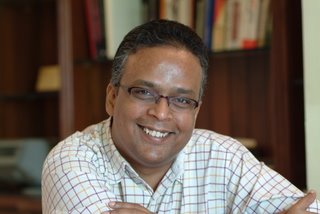
Current position held (designation and company, official address)
CEO, Euro RSCG India. 1, Brady Gladys Plaza, Senapati Bapat Marg, Lower Parel, Mumbai 400013
Office land line number
24952326
Place of birth
Patna, Bihar
Career highlights
Have been at Euro RSCG for the last 13 years. Before this I was at Lintas for 9 years. I joined Lintas straight out of IIMA. During my Lintas stint I spent 2 years in SSC&B Lintas. Behind this high inertia career path lies a lot of interesting assignments. I have been part of two start ups (SSC&B and Euro RSCG), run strategic planning for a region, been on deputation to HLL, worked on a variety of interesting and challenging clients.
Why are you good at what you do? (Answer in 10-15 words)
I fear failure and so I work hard and learn more.
Greatest influence: 15-40 words
My maternal grandmother. She was out of the box in her thinking before the term was invented.
Fantasy business partner
Steve Jobs
Biggest risk taken
None – I play safe.
Best job outside advertising/ media/ marketing
Being a father.
Favourite media
Podcasts.
Favourite gadget
Amazon Kindle
Clubs you are a member of
MCA Bandra, Club Millennium Juhu.
Most admired politician
Barack Obama
Perfect day
Sunday
Fictional hero
Phantom – the ghost who walks.
Who should play you in the film of your life?
Sidney Poitier (some people said he looked like me in “To Sir with love”)
Hidden talent
Making cocktails
Most expensive purchase
An apartment in Bandra
Desert Island favourite objects
Kindle, iPod, Laptop, power for everything.
Thursday, September 03, 2009


LEADING AN AD AGENCY
Every suit thinks he is creative. Especially suits who have risen to the top of an ad agency and therefore no longer considers himself bound by the confines of a department. So most suit CEOs don’t understand what the debate is about – you need to be creative and a suit to be the leader. ☺
Of course, the biggest trait you need to become a leader is to live in a distorted reality world and convince enough other people to believe in that distorted reality. It’s usually called “Vision” which is nothing but an attempt to twist the current reality into a desired one. If you are successful, you are a great leader. If not, you are considered a cracked pot.
The best leaders in every field lived in a distorted reality world. Buddha, Christ, Mahatma Gandhi, Steve Jobs, Ratan Tata, Barrack Obama, Piyush Pandey. All of them set out to change their existing realities in ways that perfectly reasonable people thought couldn’t be done. Who thought that India could achieve freedom thorough non-violence or that a black man could become President of the United States or that a stodgy old “people-friendly” advertising agency could become a cutting edge creative shop?
At this point, it would probably be appropriate to list out a set of traits that a good leader should have. I am going to resist the temptation.
I read a book some time ago called “Why should anyone be led by YOU?” This is the best book on leadership that I have ever read. It simply says that you can’t model yourself on any other person and still expect to be a leader. To be a leader you have to be yourself; to be authentic and real. Even have warts and weaknesses. If people like what they see, they will start to follow you.
I found this a really refreshing argument, because so many leaders fall into the trap of trying to be perfect. Leaders try to be this brilliant all rounder who could be in the team just for his batting, bowling or fielding. Not to mention his captaincy. This kind of a leader gets insecure when others appear who are better than him in any discipline. And that puts off a whole lot of followers, who tend to drift away. Thus damaging the organization.
Coming back to the central point of the debate of suit versus creative. The point I am making is that you need to be authentic and have a clear vision. If the suit is a faceless bureaucrat then he is unlikely to get any followers and therefore will not be able to achieve much.
(This piece was written for the 5th anniversary issue of Impact magazine)
Saturday, May 30, 2009
Right Sizing The Cabinet
The voters have given a clear mandate to this government to govern effectively. The people have made it quite clear that we value performance about all else.
In light of this I am dismayed to see the size of our council of ministers and the way it has been put together - with the focus being on pleasing allies and balancing regional interests. In any case, the way the government is structured is hardly conducive to good management.
Management gurus say that a manager should not have more than 7 direct reports into him. Our PM has 40 direct reports just in the council of ministers. This is not including other advisory bodies such as the Planning Commission. Clearly he cannot do justice to supervising all these people.
Several of the ministries exist for legacy reasons. Why do industries like Shipping, Mines, Coal, Textiles, Chemicals and Petroleum have separate ministries when there is anyway an Industries ministry and a labour ministry. Not to mention Finance and Commerce (although the latter is more about Exports, notwithstanding its name).
Clearly, the Cabinet and its performance would improve if we were to issue a few pink slips.
I spent a few minutes playing God (or Sonia) with the ministries and came up with these two diagrams. Figure 1 shows the 10 super ministries that would report directly into the Prime Minister (click on it to see a larger version).

The logic for the above is quite simple. To begin with we need a ministry for internal affairs and a ministry for external affairs. Those are obvious. Given our focus on development, it would be best to have ministries focused on the three main sectors of the economy - agriculture, manufacturing and services.
Next is HRD. Clearly India's big strength is its people and we all talk about the demographic dividend. Clearly there is a need to focus on people. Also I felt that in a large country like ours, transport is important enough to justify its own ministry. And going forward, we will have to find a way to grow without polluting the environment, so we need a ministry to focus on that. And finally, we need a finance ministry to focus on the money.
Those, then are the 10 super ministries.
Figure 2 shows what happened to the various other ministries. You will definitely need to click on it to be able to read it.

Most of the above seems obvious to me. The only one that I debated for a while was whether Defence needed a separate ministry. I decided against it because I feel that war is the last resort for the diplomat, and so I thought it would be best to combine the two into one ministry.
I am quite pleased with my last hour's work. Let me know what you think.
Saturday, March 21, 2009
The Importance of Grit
I have always felt that in order for a brand to sound authentic it is critical to have a little bit of dirt - something that is less than perfect. It is like Betty's sandwiches that Jughead doesn't like until they have a little bit of sand in them!
I follow a blog about fund raising for non profit organisations that found this "commercial" for Trader's Joe that sounds really authentic. Follow the words and you will see my point about grit.
I follow a blog about fund raising for non profit organisations that found this "commercial" for Trader's Joe that sounds really authentic. Follow the words and you will see my point about grit.
Friday, March 06, 2009
BJP has better orators
I'm sitting in the India Today Conclave 2009. Just heard a brilliant speech by Shivraj Singh Chouhan (CM of MP).
Last year I was impressed by Narender Modi. Another year. Another BJP Chief Minister.
Congress is represented by Ashok Chavan (CM of Maharashtra). Omar Abdullah (CM of J&K) represented the middle front.
Both spoke well, but read from prepared speeches. Shivraj had no notes but had better turns of phrase & more data.
Notice that the self made politicians speak better than those who are products of dynastic democracy.
Sent on my BlackBerry® from Hutch
Tuesday, February 10, 2009
Brands need to have social value
Friday, April 2, 1993 was supposed to be the day that brands died. That was the day when Marlboro cut its price to compete with generic brands that were 50% cheaper. The marketing world reacted with shock and promptly started funeral preparations for brands.
But brands haven’t died. They have just changed character. This article proposes one way in which brands have changed.
The starting point of the argument lies in Internet brands. Arguably the strongest brands in the world today are web brands like Google, Facebook, Second Life etc. Equally strong, perhaps, are brands like BlackBerry and iPod which have a strong web component to back up their physical products. The question arises, what is common between these brands and what can older brands learn from them?
All these brands have a social component to them. They help people connect with each other. They also create communities of users who can bond with each other. Very much like smokers of old, who could bond with each other while smoking, sharing a light etc.
Is this only a phenomenon of on-line brands or can it be taken into the real world too? I think that several brands have shown that the idea of creating social value around brands can be useful in the real world too.
The idea obviously works for Starbuck, Café Coffee Day and the like. But it goes much beyond.
My favourite example in India is the Jaggo Re campaign for Tata Tea. It is creating a community of young people who are concerned about the future of their country and want to influence its course. There is a strong product connect and it is based on a strong insight of how Indian youth thinks. The campaign for Idea is on a similar line.
We at Euro RSCG have experimented with portraying the new “chalta-nahi-hai” attitude of youth in our campaign for Dainik Bhaskar – Zidd karo. Before that we created the “India ka dil, India ka AC” campaign for Voltas.
So what do the success of the above commercials mean? We are used to thinking of the rational value of a brand and the emotional value of a brand. Now we have to think also of the social value of the brand.
This social value helps define the users and fans of the brand into a community. Once the community has been defined the brand needs to provide its “members” (not just consumers) with a platform through which they can communicate with each other and with the brand. This is how the strong brands of the future will be built.
In conclusion, I don’t think that brands are dead. They have just acquired an additional layer – the social layer. Brand handlers now need to be conscious of this new rule in the game.
The above article has been written for the Mint, but they will probably not publish it as it is.
Saturday, February 07, 2009
License to harrass
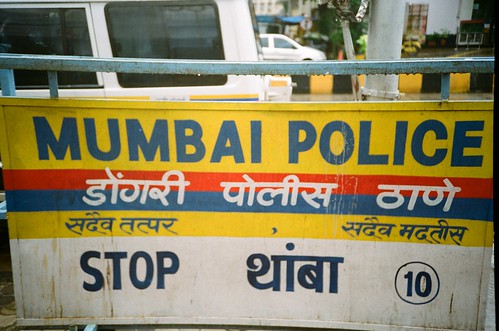 There are numerous road blocks in the city which slow down traffic and cause huge traffic jams, but which are not manned by any human beings! So why are they there?
The one I see most often is the one at the airport just as you come out of the Terminal 1A. 4 lanes of traffic has to slow down to squeeze through the road block one vehicle at a time. While the cops who are supposed to be checking the cars are presumably having tea somewhere.
Of course, everyone has often wondered what they are checking for anyway. But we'll talk about that another day. For now, I just wish that the cops would open up the roads at least when they are not on duty there.
Warren Buffet's Thoughts for 2009:

We begin this New Year with dampened enthusiasm and dented optimism. Our happiness is diluted and our peace is threatened by the financial illness that has infected our families, organisations and nations. Everyone is desperate to find a remedy that will cure their financial illness and help them recover their financial health. They expect the financial experts to provide them with remedies, forgetting the fact that it is these experts who created this financial mess.
Every new year, I adopt a couple of old maxims as my beacons to guide my future. This self-prescribed therapy has ensured that with each passing year, I grow wiser and not older. This year, I invite you to tap into the financial wisdom of our elders along with me, and become financially wiser.
Hard work: All hard work brings profit; but mere talk leads only to poverty.
Laziness: A sleeping lobster is carried away by the water current.
Earnings: Never depend on a single source of income.
Spending: If you buy things you don't need, you'll soon sell things you need.
Savings: Don't save what is left after spending; Spend what is left after saving.
Borrowings: The borrower becomes the lender's slave.
Accounting: It's no use carrying an umbrella, if your shoes are leaking.
Auditing: Beware of little expenses; a small leak can sink a large ship.
Risk-taking: Never test the depth of the river with both feet.
Investment: Don't put all your eggs in one basket.
I'm certain that those who have already been practicing these principles remain financially healthy. I'm equally confident that those who resolve to start practicing these principles will quickly regain their financial health.
Let us become wiser and lead a happy, healthy, prosperous and peaceful life.
Sunday, January 18, 2009
Late-comers are from Venus

I think too much has been made out of this men are from mars and women
from venus thing. I think if you really want to study two different
species, you ought to look at people who are habitually on time and
those who are always late.
I belong to the first species and have been surrounded by people who
are habitual late-comers. At home, in office, among my friends – this
other species dominates the population nearly as much as right handers
do.
In order to further the cause of science, I offer below a few
characteristics of this species. To begin with let's give them a
name. I like to call them Homo Latiens to distinguish them from the
rest of us Home Sapiens.
1. Home Latiens always make you wait, but hate to wait themselves.
They make sure that they find something else to do that takes a little
longer than what you are doing, so that you end up waiting.
2. You can't out-late a Homo Latien. This is a corollary of the first
statement. If you think you can be later than them, all I can say to
you is "Ha!"
3. Homo Latiens are amazing at multi-tasking. See picture above.
4. Homo Latiens are absent minded. They always forget the most
important things. Their wallets. The projector. The file. The
gift. The keys. Then they have to go back and get it while you wait.
5. Homo Latiens think they are super efficient. They think everything
will get done in 5 minutes. Or in a jiffy. Whichever takes less
time. Home Sapiens tend to think in much longer time segments.
6. Homo Latiens think the last lap takes the most amount of time.
Having delayed themselves and everybody else, a typical Homo Latien
will sprint the last lap to the car, the door, down the steps or
whatever. Thus making up for lost time.
7. Homo Latiens are emergency prone. Somehow emergencies always seem
to crop up in their lives. That's actually what makes them late.
Somehow Homo Sapiens don't have so many emergencies. Please note that
going to the loo at the last minute counts as an emergency.
I would welcome further study into this species and in how the two
species – homo sapiens and homo latiens - interact with each other.
Tuesday, December 09, 2008
Trousers take over the dhoti
The Economic Times of December 6, 2008 reported that 55% of all
readymade trousers sold in India were sold in rural areas. This is
good news. It shows the depth of our retail market, the increased
prosperity of the rural areas and a welcome spread of modernization.
readymade trousers sold in India were sold in rural areas. This is
good news. It shows the depth of our retail market, the increased
prosperity of the rural areas and a welcome spread of modernization.
Some may bemoan the erosion of our ethnic culture. But since most of
the people who will so crib, will do so while wearing western clothes,
we needn't take them seriously.
Now the only people wearing dhotis would be the smart set. Like
friend Amir!

Subscribe to:
Posts (Atom)