Friday, April 2, 1993 was supposed to be the day that brands died. That was the day when Marlboro cut its price to compete with generic brands that were 50% cheaper. The marketing world reacted with shock and promptly started funeral preparations for brands.
But brands haven’t died. They have just changed character. This article proposes one way in which brands have changed.
The starting point of the argument lies in Internet brands. Arguably the strongest brands in the world today are web brands like Google, Facebook, Second Life etc. Equally strong, perhaps, are brands like BlackBerry and iPod which have a strong web component to back up their physical products. The question arises, what is common between these brands and what can older brands learn from them?
All these brands have a social component to them. They help people connect with each other. They also create communities of users who can bond with each other. Very much like smokers of old, who could bond with each other while smoking, sharing a light etc.
Is this only a phenomenon of on-line brands or can it be taken into the real world too? I think that several brands have shown that the idea of creating social value around brands can be useful in the real world too.
The idea obviously works for Starbuck, Café Coffee Day and the like. But it goes much beyond.
My favourite example in India is the Jaggo Re campaign for Tata Tea. It is creating a community of young people who are concerned about the future of their country and want to influence its course. There is a strong product connect and it is based on a strong insight of how Indian youth thinks. The campaign for Idea is on a similar line.
We at Euro RSCG have experimented with portraying the new “chalta-nahi-hai” attitude of youth in our campaign for Dainik Bhaskar – Zidd karo. Before that we created the “India ka dil, India ka AC” campaign for Voltas.
So what do the success of the above commercials mean? We are used to thinking of the rational value of a brand and the emotional value of a brand. Now we have to think also of the social value of the brand.
This social value helps define the users and fans of the brand into a community. Once the community has been defined the brand needs to provide its “members” (not just consumers) with a platform through which they can communicate with each other and with the brand. This is how the strong brands of the future will be built.
In conclusion, I don’t think that brands are dead. They have just acquired an additional layer – the social layer. Brand handlers now need to be conscious of this new rule in the game.
The above article has been written for the Mint, but they will probably not publish it as it is.
Tuesday, February 10, 2009


Saturday, February 07, 2009
License to harrass
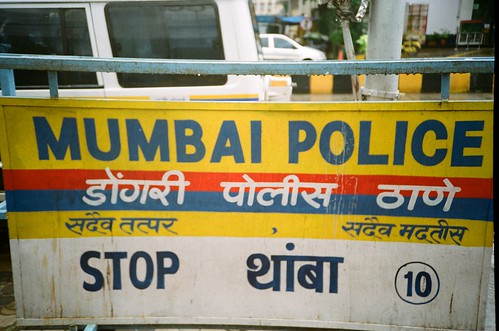 There are numerous road blocks in the city which slow down traffic and cause huge traffic jams, but which are not manned by any human beings! So why are they there?
 The one I see most often is the one at the airport just as you come out of the Terminal 1A. 4 lanes of traffic has to slow down to squeeze through the road block one vehicle at a time. While the cops who are supposed to be checking the cars are presumably having tea somewhere.
Of course, everyone has often wondered what they are checking for anyway. But we'll talk about that another day. For now, I just wish that the cops would open up the roads at least when they are not on duty there.
Warren Buffet's Thoughts for 2009:

We begin this New Year with dampened enthusiasm and dented optimism. Our happiness is diluted and our peace is threatened by the financial illness that has infected our families, organisations and nations. Everyone is desperate to find a remedy that will cure their financial illness and help them recover their financial health. They expect the financial experts to provide them with remedies, forgetting the fact that it is these experts who created this financial mess.
Every new year, I adopt a couple of old maxims as my beacons to guide my future. This self-prescribed therapy has ensured that with each passing year, I grow wiser and not older. This year, I invite you to tap into the financial wisdom of our elders along with me, and become financially wiser.
Hard work: All hard work brings profit; but mere talk leads only to poverty.
Laziness: A sleeping lobster is carried away by the water current.
Earnings: Never depend on a single source of income.
Spending: If you buy things you don't need, you'll soon sell things you need.
Savings: Don't save what is left after spending; Spend what is left after saving.
Borrowings: The borrower becomes the lender's slave.
Accounting: It's no use carrying an umbrella, if your shoes are leaking.
Auditing: Beware of little expenses; a small leak can sink a large ship.
Risk-taking: Never test the depth of the river with both feet.
Investment: Don't put all your eggs in one basket.
I'm certain that those who have already been practicing these principles remain financially healthy. I'm equally confident that those who resolve to start practicing these principles will quickly regain their financial health.
Let us become wiser and lead a happy, healthy, prosperous and peaceful life.
Sunday, January 18, 2009
Late-comers are from Venus

I think too much has been made out of this men are from mars and women
from venus thing. I think if you really want to study two different
species, you ought to look at people who are habitually on time and
those who are always late.
I belong to the first species and have been surrounded by people who
are habitual late-comers. At home, in office, among my friends – this
other species dominates the population nearly as much as right handers
do.
In order to further the cause of science, I offer below a few
characteristics of this species. To begin with let's give them a
name. I like to call them Homo Latiens to distinguish them from the
rest of us Home Sapiens.
1. Home Latiens always make you wait, but hate to wait themselves.
They make sure that they find something else to do that takes a little
longer than what you are doing, so that you end up waiting.
2. You can't out-late a Homo Latien. This is a corollary of the first
statement. If you think you can be later than them, all I can say to
you is "Ha!"
3. Homo Latiens are amazing at multi-tasking. See picture above.
4. Homo Latiens are absent minded. They always forget the most
important things. Their wallets. The projector. The file. The
gift. The keys. Then they have to go back and get it while you wait.
5. Homo Latiens think they are super efficient. They think everything
will get done in 5 minutes. Or in a jiffy. Whichever takes less
time. Home Sapiens tend to think in much longer time segments.
6. Homo Latiens think the last lap takes the most amount of time.
Having delayed themselves and everybody else, a typical Homo Latien
will sprint the last lap to the car, the door, down the steps or
whatever. Thus making up for lost time.
7. Homo Latiens are emergency prone. Somehow emergencies always seem
to crop up in their lives. That's actually what makes them late.
Somehow Homo Sapiens don't have so many emergencies. Please note that
going to the loo at the last minute counts as an emergency.
I would welcome further study into this species and in how the two
species – homo sapiens and homo latiens - interact with each other.
Tuesday, December 09, 2008
Trousers take over the dhoti
The Economic Times of December 6, 2008 reported that 55% of all
readymade trousers sold in India were sold in rural areas. This is
good news. It shows the depth of our retail market, the increased
prosperity of the rural areas and a welcome spread of modernization.
readymade trousers sold in India were sold in rural areas. This is
good news. It shows the depth of our retail market, the increased
prosperity of the rural areas and a welcome spread of modernization.
Some may bemoan the erosion of our ethnic culture. But since most of
the people who will so crib, will do so while wearing western clothes,
we needn't take them seriously.
Now the only people wearing dhotis would be the smart set. Like
friend Amir!

Saturday, November 29, 2008
Professionalize politics

Right now we are all angry. We want something to be done. Something that will protect us in future. That will prevent a recurrence of what has happened.
And then we look at the people that we have elected to do something. That sends us into a new bout of despair. How can these people be expected to perform? These people are the dregs of our society. Remember that someone said that "politics was the last refuge of the scoundrel". That someone was right. Just look at them, their backgrounds and their track records.

So what is to be done? Clearly better people need to join politics. But why would better people join politics? What's in it for them?
Today politics is a career that does not pay if you are honest. The assumption is that you already have a career and having achieved all that you wanted to, you are now willing to work for the good of the country. Or that you are so selfless that you are willing to work for society without worrying about your own comfort.
This is clearly not working. This idealistic model is precisely what has led to the scoundrels ruling us. And that leads to the kind of disastrous situations that we have gone through.
So are there any better models that we can think of?
Plato said that the ruling elite were a different kind of a breed and suggested that they be identified when young and bred separately. They would be educated in a special kind of a way to ensure that they were good leaders. They would not marry, not would they need to earn a living, but their needs would be taken care of by the state.
Plato has been condemned as being idealistic and impractical. So his idea has never been seriously considered.
But is there something in there somewhere? Can we modify it to suit modern needs?
I think we could easily evolve an aptitude test that tests competence of people to be national leaders. Every politician should be required to take such a test before he can file his election papers.
Having identified a core set of people who have the interest and aptitude to rule, we need to find a way to ensure that they can make a living without being corrupt. Each politician who has passed the exam must get a salary that enables them to live comfortably while focusing on social work. There must be incentives to make these people rise up the hierarchy and ultimately become national leaders.
That way we would ensure that the country is ruled by a set of competent and professional people. People who we can trust to do a good job.
This idea is simplistic at this stage. But I think there are elements that are interesting and deserves to be developed into a workable system. Clearly the country needs it.
Saturday, November 08, 2008
What A Cry Baby

Australians can dish it out, but can't take it. This has been proven several times on the cricket field. Here is the latest instance.
Ian Chappell is on air complaining about India bowling with 8 fielders on the off and using "over rates as a tactic". If Australia had been using these same tactics, he would have been praising their professionalism especially if the tactics had paid off. Well the tactics have paid off for India and Australia is in some trouble (at tea time on day 3).
Come on Ian. Don't be such a cry baby just because you guys are in danger of losing the series. Remember that last ball bowled under arm by your brother Trevor, on instructions from your other brother, Greg?
Saturday, October 18, 2008
Insights into the young Indian
Everyone born before 1980 in India is a foreigner in his own country. The current generation thinks and behaves so differently from its predecessors, that it is OK to feel bewildered. Here are a few commonly held myths and the reality as captured by repeated studies done by Euro RSCG in India.
Before we get into the myths, a few words about the source of our data. We have interviewed over 4000 people in 20 cities over the last two years. We have a technique that predicts trends by studying what opinion spreaders think today. The "reality" below are not universal realities yet, but reflect the trends that we have spotted in the Indian market.
Myth: Young people always rebel against their parents.
That is so 1960s. Flower power and all that. Today's youth thinks that the most important role models for them are their parents. Parents rank way higher than iconic figures like Shahrukh Khan, Mahender Singh Dhoni and Barkha Dutt.
Dhoni and Barkha Dutt. Keep those two names in mind as you read further.
Myth: Trends trickle down from the big cities like Mumbai and Delhi.
Don't even mention this to Dhoni. Or to Sunil Mittal. Or the champion boxers from Bhiwani. These stars of today are not learning from their big city colleagues - they are teaching them. Teaching them the softer skills of winning. Teaching them values and a new work ethic. It is for this reason that we believe today's trends are not trickling down, but bubbling up.
Myth: Young people in India need help to succeed.
The stars we spoke of earlier, back themselves with an extremely high level of self belief. They are confident, almost arrogantly so. And they know that they will make their dreams come true. No matter what.
Today's youngster believes that she doesn't need to be born into a privileged family to achieve greatness. Apart from the usual sporting heroes, they point to a Barkha Dutt who has already had a movie made on her life. And she is still young!
Myth: Youth dream of America.
No longer. Even before the sub prime crisis and the economic meltdown, Indian youth had cooled off on the great American dream. They would still like to visit Firangland, but they don't want to go and live there. They are proud to be Indian and want to raise their families here.
Not only that, they no longer want to pay premiums for the "Foreign made" label. They actually believe that products made in India are more suited to local conditions and local hair and skin types. Quite a far cry from the days when even "export reject" products commanded a premium.
Myth: Indian women are either doormats or militant feminists.
For societies to change, women have to change first. Indian women are experiencing really dramatic changes. All the above insights apply to her, of course. But in addition we have to understand here new balanced approach to life.
Earlier women defined themselves by their roles. She was somebody's wife, mother, daughter or daughter in law. On the other extreme, she became a militant feminist like Rajani or Lalitaji. Today's women have developed a whole new approach. They have strong views on everything and a pretty clear set of objectives to achieve. However they are flexible in the route to achieving those objectives. They try to take others along rather than just bulldoze through the system. This "strategic" approach can be seen in movies and TV serials. Jassi in "Jassi jaisi koi nahin" was a good example.
So why are these dramatic changes taking place? Why is it that older people have become foreigners in their own land? Our belief is that there is a violent cultural remixing taking place in India and some other emerging markets. Global culture is colliding quite suddenly and dramatically with a strong entrenched local culture. The resultant is a hybrid that is as new and exciting as the culture of the flower power years.
But why now? There are a few reasons why the remixing is happening more now than ever before.
Older people are used to thinking of India as an agrarian economy. Jai Jawan Jai Kisan has been a slogan from the mid 1960s at least. Today that is no longer true. Only 21% of our GDP comes from agriculture and around one third of our people derive their incomes from it. India is today a service economy and people haven't quite got their heads around that fact.
The second big change is the rise of the backward castes in India's economic and political life. This is a politically incorrect subject to discuss, but I believe that today's business leaders all have a brahmanical view of the world, which is out of sorts with the current reality.
Aside from the two big changes, there are several smaller changes taking place. This is the third generation of nuclear families and so the ties of the joint family system are all gone. And with it are gone the old traditions and customs. Indians are seeing the world more - either through travel or through the media coming into their homes. This is broadening their minds and extending their horizons.
All these changes have taken place in a very quick time. Just a little more than a decade. In the context of cultural changes, that is a mere instant.
No wonder, us old fogies are feeling disoriented.
Sunday, October 12, 2008
Sad
11 Oct 2008, 0311 hrs IST, Sanjeev Kumar Verma,TNN |
Jayaprakash Narayan, or JP as he was widely known, gave the historic call for Sampoorna Kranti or Total Revolution from Patna's Gandhi Maidan in 1974. However, Sampoorna Kranti is today known more as a Patna-Delhi train and JP's birthday, October 11, is revered more as cine star Amitabh Bachchan's date of birth by most of Patna's sophomores. Ask Abhimanyu Kumar Singh, a Class XI student, what does he know about Sampoorna Kranti, and pat comes the reply, "It's an express train between Patna and Delhi." His classmate, albeit in another school, Mausam Shreshta offered a similar answer. Even clues couldn't help Abhimanyu and Mausam come up with any knowledge about JP. Ironically, even college students TOI spoke to were no less ignorant. "Sampoorna Kranti is a train but there is something more about it which I don't know," candidly confessed Brajesh, who is doing honours in History from a local college. "October 11 is the day when Big B was born," was how most of the city youths described the import of the day. Only a few could recall it also happened to be JP's birth anniversary, but only after they were given clues. "Big B immediately hits your mind as his birthday is widely covered by the media," one of them thus explained his ignorance. Student leader Ramashanker Sinha is not amused. "The state has been ruled by JP's disciples for so many years, but none of them bothered to do anything concrete for making the young ones understand the importance of the leader who is credited with ushering in a new era in Indian politics," Sinha said. Agreed state's public health and engineering department (PHED) minister Ashwini Kumar Choubey, himself a product of JP movement. "While the previous governments having JP's disciples at the helm did nothing to educate the young ones about JP and his ideas, even our government in the first three years of its rule has not been able to do much on this front," he said. Choubey said there is a need to organise special programmes in schools and colleges at least four times in a year — on the birth and death anniversaries of JP; on March 18, the day he led a silent procession in Patna in 1974 and on June 5, when he coined the concept of Total Revolution the same year. "Our youngsters would thus know JP," he said. |
Saturday, September 27, 2008
Browsing

The good thing about blogs is that there are no editors around. Editors are the natural enemies of writers. Magazine editors are the worst of the lot because they have a space constraint in addition to their natural instinct to "improve" the piece.
Anyway, Business World magazine asked me to write about books I was reading and, in general, about my reading habits. My responses are given below. They then published an "edited" version that is shown in the picture alongside. You judge whether the editor did a good job.
Q: Which book are you reading at the moment and why did you pick it up?
A: I am reading “The last lecture” by Randy Pausch. I watched the video of the lecture just after Randy Pausch died. I found the lecture absolutely fascinating. I have therefore bought the book to read in greater detail.
Q: What you have learned so far from the book?
A: Fascinating book about the values that helped him achieve his childhood dreams. These are the lessons that he wants to tell his children about, but had no other way of communicating since the author was dying of cancer. I find such books inspiring and uplifting.
Q: Is it the kind of book you normally read? If not, what is your preferred reading (fiction, management, self-help, spiritual etc)?
A: I normally read non fiction books that cover a wide range of topics from physics to philosophy, from Indian culture to management, from biographies to humour. I firmly believe in the dictum that facts are stranger than fiction. If you want to know more about the books I read or recommend, go to my blog (sumansrivastava.blogspot.com) and look at the “Favourite books” box on the left hand side. I have a list of books that I have read with my ratings for them. Among my all time favourites:
May you be the mother of a hundred sons by Elisabeth Bumiller
What should I do with my life? By Po Bronson
The Razor’s Edge by Somerset Maugham
Q: How do you buy your books (based on reviews, browsing on the Net, favourite bookstore etc)?
A: I buy books almost indiscriminately much to the despair of my wife. I enter book stores whenever I can - there is a Crossword very close to my house in Bandra, and I also go into book shops in airports. I buy whatever catches my fancy. I also read a lot about books in magazines and hear podcasts about them. One of my favourite book reviewers is NPR (National Public Radio). I listen to their book reviews via podcasts.
Q: What are some of the other books on your reading list at the moment.
A: I get nervous if my “to read” shelf at home is empty. So I always keep it stocked. Currently among the books bought and waiting to be read are:
Sea of Poppies by Amitav Ghosh
Billions of Entrepreneurs by Tarun Khanna
Myth = Mithya by Devdutt Pattanaik
Subscribe to:
Posts (Atom)