Sunday, March 16, 2008

THE SECRET INDIA TODAY CONCLAVE


I have spent the last 2 and a half days at the India Today Conclave in Delhi. It was a superb event with lots of very interesting speakers. Unfortunately this conference not been covered widely in our media, because media groups do not allow coverage of each other's events. Its really petty when you think that the news media in India covers such inane news most of the time, and yet couldn't (or didn't) cover excellent speeches by a glittering array of speakers. So much so that just now when I searched for "India Today Conclave" on Google, it didn't show up any results! Of course, the India Today group does have very extensive coverage of the event - you can read the reports, watch the videos and look at the pictures by clicking here.

So in my own small way, I shall now fill the breach and tell the two and a half people who read my blog, all about the conclave. Or at least, the bits that impressed me the most.

Space tourism is here. We got to see a model of the plane that will launch the space vehicle, a model of the space vehicle, a video of the first test flight and an animation video of what it will be like when the space vehicle goes up with passengers. All this was presented to us by Stephen Attenborough, commercial director, Virgin Galactic. The most amazing bits about the space travel are the two breakthrough innovations that are going to make space travel cheaper and safer at the same time. One is the idea of launching the "rocket" from the air rather than the ground. It requires less energy and is safer because if something goes wrong, the rocket can simply glide down to earth. The second idea is to have rotating wings that turn to slow down the vehicle's re-entry into the atmosphere and ensures that it is not as stressful an event as it has been for the space shuttles. Difficult to explain in a few words, but you might like to go to
Virgin Galactic's site and watch the flash videos about the technology.

Sunil Mittal and Wim Elfrink, Chief Global Officer of Cisco, made excellent presentations on the future of communications. Not just about what technology is going to do, but how it will affect human beings. Sunil spoke about empowerment of people the mobile phone will be the identity card and the credit card for the poor. He also made a fervent appeal to not have any more regulators for his industry. Mr. Elfrink showed us the benefits of "Tele-presence" and how that would change the way we live and work.

Now that I have revealed my fascination for technology by opening this piece with the most techy bits, let me move on to the other people were fascinating.
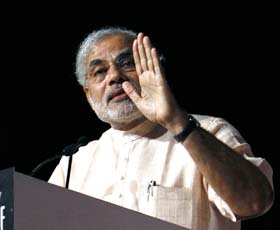
Narendra Modi, Vikram Akula, Yasin Malik and Peter Roebuck were the speakers who made the biggest impression on me. That is saying something since the other speakers included Bill Clinton, Al Gore, L K Advani, Chidambaram, Mukesh Ambani, Adam Gilchrist, Amir Khan, Preity Zinta, Sachin Pilot, Farookh Abdullah, Digvijay Singh, Bishen Bedi, Ashok Amritraj and Craig Venter.

I must also mention in this context that some of the moderators were brilliant too. Aron Purie, Anand Mahindra, Shekhar Kapur and Prabhu Chawla excelled in this role. I have never seen such high quality moderation at any panel discussion before.

Narendra Modi & Yasin Malik (the Kashmir Liberation Front leader who is fighting for an independent Kashmir) were the two anti-heroes who came to the conclave. I think everyone was very curious about these two people and we were not disappointed. They both put forward their views in a very forceful and convincing manner. After the session where Mr Modi spoke, I asked many people who they would vote for between him, Digvijay Singh and Farooq Abdullah. Mr Modi was the clear people's choice.

I didn't dare do a similar exercise after Yasin Malik's speech. I did put my foot in my mouth by saying that I was impressed by him to a person who, I later discovered, was a Kashmiri Pandit. This gentleman was already seething and he just let me have it. He called Malik a murderer, a rapist and a terrorist and criticized the India Today people for having him at the conclave. He was not alone. A few people were demonstrating outside the hotel and one person actually entered the hall and shouted to have the event stopped. He was escorted out by the security people.

Mr. Al Gore’s speech was billed as the highlight of the conclave. The turnout for this absolutely amazing. Half the Indian cabinet (including Mr. Chidambaram) were present. All the speakers stayed on to listen to him – this included film stars like Preity Zinta and Amir Khan. All the industrialists came back from their meetings. (I even noticed Mr. & Mrs Adi Godrej, who seemed to have flown in from Bombay just for this.) The décor of the hall was changed to reflect the “green” look, and the who’s who of Delhi turned out in their most designer clothes.

In the end, the speech was a little disappointing. I guess it is tough to live up to such hype. Especially when you have just one theme to talk about and everyone has seen the movie where you said it all. Still, he did very well in the Q&A. I noticed that Mr. Aroon Purie only allowed the high and mighty to ask questions of Mr. Gore.

The conclave was exceptional in the wide range of topics that it covered. The theme was “Leadership in the 21st century”. Sessions were ear marked to study leadership issues in communication, ethics, spirituality, sports, entertainment, the environment etc. There was even a youth forum where speakers spoke on what they would do if they could change the world. This is where Vikram Akula, who is India’s answer to Mohammad Yunus, said he would like everyone of the top 20% of India’s population to spend one day living the life of the bottom 80%. He believes that will generate empathy and create the conditions for real change to take place.

Its tiring sitting in those uncomfortable chairs all day for two and a half days. One eats a lot and doesn’t exercise at all. But in this conference, the mind got good food and good exercise. Thank you India Today for that.


Saturday, March 08, 2008

OF FASHION SHOWS & CREATIVE AWARDS

Scam ads.

Two short words that stir up a lot of debate and strong feelings. Clients & competitors snigger at them. Creative people hate the term and fiercely defend the concept. Journalists ask award show organizers their stance on scam ads. Award juries spend more time debating whether an ad was a scam than its intrinsic merits.

Fashion shows.

A ceremony where designers show off clothes that nobody would wear in normal life. Where celebrities, critics, journalists and the public go into raptures about the relative merits and talents of the designers. Where only the most naïve and forthright people question the need for creating those dresses. So why aren’t those clothes called Scam dresses?

Formula 1.

A car race for cars that can’t be driven on normal roads with normal traffic. Where car, tyre, fuel and lubricant manufacturers jostle to create cutting edge products that aren’t for the lay public. Another place which generates a lot of passion and excitement but where nobody talks of scams.

I could go on with examples from other industries and other walks of life. But let’s now address the key question. Why is it that only advertising gets the label of “scam” and why is it that only we talk about it so much?

The answer probably emanates from a misunderstanding about the nature and purpose of creative awards.

Creative awards are meant to recognize work that has pushed the boundaries of communication. Effectiveness awards recognize work that has pushed sales or other results for the client. In the context of cars, Formula 1 races are creative awards, while car rallies are effectiveness awards. Get the difference?

I think juries of creative awards should be looking for unique insights, creative expressions and execution techniques. These insights, expressions and techniques could be demonstrated in the form of scam ads. That’s fine. What is important is their brilliance, their creativity.

Perhaps creative awards should drop the criteria that an entry needs to have been done for a real client and released. Why is that essential? If I have a brilliant insight for selling cars, then I should be allowed to use that insight in an ad that I create for a fictitious car and enter it for awards. If the idea is really great, then I should get an award.

Dropping these two criteria (or real client and release) would release ad agencies from a huge moral dilemma and also save the industry a lot of money. We all know that scam ads get released either at agency expense or by culling favours. Shouldn’t we just abandon this hypocrisy?

The advertising industry doesn’t have much of a R&D budget. We may do the occasional research, but that is usually to get PR for our companies rather than to genuinely unearth new insights. But there is a huge opportunity for turning creative awards into an engine for industry wide R&D.

This is where we can develop path breaking insights, expressions and techniques that would then be used (perhaps in a modified or watered down manner) for normal everyday work. Insisting that path breaking work be released is like asking Albert Einstein the practical uses of the theory of relativity. There are uses, but not all of them are apparent when the theory is first propounded.

Once we make it clear that creative awards do not need to be done for a real client, we are free from the constraints of that brand’s guidelines. We are out into the scary green fields of pure creativity. If we can then create something that makes the whole industry gasp – a show stopper in a fashion show – then we really do deserve all the accolades that we can get.

Monday, February 25, 2008

Gold jewellery no more Indian bride's best friend

That's the title of an article that I read just now (click here to read the original article). A couple of thoughts about this "trend"?

My first thought was to feel happy that finally we are letting go of our irrational love for the yellow metal. Although I think we are so much in the lead as the biggest hoarders of gold, that it will take a long time for us to fall from the top slot.

The second thought is happiness again that the Indian woman is feeling so economically liberated and secure that she doesn't feel the need to hoard gold. I don't think the price of gold has anything to do with her not buying more (as this article suggests). In fact quite the contrary. If the price of gold goes up then that is so much more reason to buy gold and keep as an insurance.

Clearly she doesn't need the insurance that much. That is why she would rather have a laptop and that plasma TV. And what of the future? Well, that's what the mutual funds are for!

Friday, December 14, 2007

Dialogue@Exchange4media.com

"The Indian consumer and culture have changed. They have become more remixed, where we are taking some aspects of Anglo-Saxon and mixing it with Indian culture. I believe there isn't any other agency that is doing brilliant work of consistently talking to this new remixed consumer. Our opportunity is to be this agency that talks to this remixed consumer in the most relevant way and offer creative solutions based on the insights that we get from the remixed generation."

Suman Srivastava, CEO, Euro RSCG


Suman Srivastava, a graduate from IIM Ahmedabad, is the CEO of Euro RSCG India. He joined Lowe in 1987 where he spent eight years. In 1994, Srivastava moved to SSC&B Lintas and was instrumental in building the agency. He left SSC&B Lintas to join Euro RSCG in 1996. Since then, he has been spearheading the agency's India operations.

In conversation with Rishi Vora of exchange4media, Srivastava talks about the challenges facing the advertising industry. Excerpts:


Q.

You have been in the advertising industry since 1987. How do you think has the industry evolved since the days you started your career in advertising?


A.

The biggest change that has taken place in the industry is that we have moved from the commission-based revenue model to one that is fee-based. Today we have more focus on integrated communication rather than purely advertising. Plus, unlike the earlier days, there are a lot of young people today who want to get into the industry, and thus the position of advertising as an industry has changed, in terms of scouting talent. Today talent is available and you just have to recogise, groom and retain.

Another big change is that Indian agencies now have integrated with their global counterparts, unlike before, when a local branch of an international agency had nothing to do with the operations of its parent company. There is much more equity ownership today; we see a lot of interaction with global network CEOs who are now visiting their India offices on a regular basis. To put it precisely, I think the importance of India in the global network has increased.


Q.

I understand that the market in the early 1990s was emerging, and since then there has been a lot of changes in the industry. Has the industry matured to some extent? Where do you see the revenue curve of the industry going?


A.

I don't think the market has matured. I think we are in the early growth stage of our development. If you look at any parameter that gives you an idea of ad revenues, we are way lower than even our neighbouring countries like South East Asia or the Middle East. Plus, if you compare the industry with other emerging markets, you would see that our spends are comparatively lower. I think the industry is growing pretty rapidly if you look at the ad spends of last two years. I think our industry has a lot more years of growth left before we can call it a matured one.

The industry is more multi-dimensional, and I think we are only getting more professional in our approaches. The quality of our work over the years has improved dramatically. Most importantly, we now have an Indian way of advertising that is not a derivative of an American or Anglo-Saxon way. But there's so much more to understand, like the insights into the Indian consumers. I am saying this because there have been a few examples, which are not really Indian insights but are adaptations from the West. I would argue that most advertising professionals are not bothered to go out and meet consumers to get insights.


Q.

As you say that ad spends are less, do you indicate that ad rates are lower in the industry as compared to international standards?


A.

That's true. The rates are much way lower. Forget the US, the ad spends that we have in India are lower than even the Middle East. Also, the reach of our media is inadequate and low. The rates are lower, the compensation agencies get is lower, and hence the overall spending is also low. These are early days of development of the Indian economy, and as the economy develops and competition increases, the Indian communication industry will get larger and professional in approach.


Q.

What is the average agency compensation in the industry? How much is yours?


A.

For us, more than 70 per cent of the total earnings come from fees, while the remaining comes from production. The media commission and the share of creative agencies have become very small. Also, media agencies are working on flat fees rather than commission. This is the change that has taken place in the industry, and I think it's a good change.


Q.

There is a rift between media and creative. Do you think the two should merge? What do you think is good for the industry?


A.

I think this rift will continue to exist for a long time. But if you ask me what is good, I certainly believe that both media and the creative have to merge, and there is no other way out. We keep on saying that integration is a big story. But the biggest integration that clients want is that of media and creative. When will this happen is a difficult question to answer. But I am sure this will happen with some changes. Let's say that Euro RSCG in New York has a designation such as 'Creative Director-Media' and his job is to think of innovation in media. So clearly if you break up the media function, there is a strategy part of media, a creative part, a trading and negotiating part, and then the operations part. I think strategy and creative parts of media is something that creative agencies have to offer their clients.


Q.

Do you think the buying pattern of media will change over a period of time?


A.

The buying aspects of the media, whether that too comes back or goes to a client, is what we have to see. For instance, when clients start buying from media channels, transactions become cleaner. You may never know that we may have a completely different set of model in future.


Q.

What do you think are the major loopholes for a media agency in India?


A.

One of the big issues for a media agency is the amount of 'outstandings' we have in the industry today. If one client defaults, then there is complete chaos for the media agency. So may be in the future there will be some way to ensure that there are no losses from the outstandings. Would there be brokers, financial companies or insurance agencies that would step in to ensure media owners and media agencies against non-payment? One doesn't know how things would evolve.

I think it is naïve to think that we will go back to the kind of an integrated agency that existed 10 years ago. However, I don't think the agency structures have ceased to evolve and there will be more changes as we go forward.


Q.

How have you seen Euro evolve and grow under your leadership since 1996?


A.

Euro has done very well. From 1995 to 1997, we doubled; and when I took over, I had informed the media that my target was 2x3y, which was to double the revenue in three years. We have actually done it 2x2y –we have doubled in two years. Now whether we can keep this momentum on is something we really don't know. But frankly, we have been lucky that we have grown while there was tremendous growth in the industry and in the economy.

On the side of the creative products, I think we have done well in the last year and half. We have done several pieces of work that I am proud of, like the Voltas campaign, our works for Red FM and Cobra, the ongoing Mac Lubricants campaign with Dhoni. We have just released a campaign on Volvo, which again is very interesting.

At Euro, we have also changed the way we practice. We now have only one P&L for each of our regions –Mumbai, Delhi and South – and all services now report to the Director of the respective regions. The marketing and PR services offer true integration to clients. Moreover, our 'Bunty Syndrome' is an example of how new things create thought leadership in their respective category.


Q.

What was your vision for Euro RSCG when you joined the agency? How far have you reached in achieving this vision?


A.

This thing called vision scares me a little bit. I don't think I took this job to change things. Euro RSCG was performing well those days and it was a question of just continuing the good work. But there were a several things we needed to do. We had to grow and improve our creative product. We set ourselves short-term targets and we have achieved some. The biggest thing that we have done is improved the image of the agency. Our reality is much better than our perception. I think this is good in a way, but that is one area we are working on.


Q.

Euro RSCG is big internationally, but not so in India. Your comments...


A.

While we are one of the largest agencies, we actually have an image problem in many parts of the world. The reason is that in many of the developed markets, we were not known as Euro RSCG since we grew by acquisitions in countries like South East Asia, New York and some others.

It is only a few yeas ago that we made the transition of being known as the Euro RSCG network. We are still a teenage brand with 16 years of international presence and having completed 12 years in India. If you compare this with other big agencies in India, most of them have been in existence since 50-60 years. Euro started in France and Europe, and is very strong there. But in the US, we are slowly and gradually moving towards being one of the best agencies there.


Q.

What is the Euro India philosophy?


A.

We are trying to evolve what I like to call 'remixed philosophy'. Twenty years ago when I started my career in advertising, good advertising was a derivative of the Anglo-Saxon and the very English kind. Subsequently, Indian advertising has developed what I would like to call 'Hindi idiom', which at least becomes our own medium.

The Indian consumer and culture have changed. They have become more remixed, where we are taking some aspects of Anglo-Saxon and mixing it with Indian culture. I believe there isn't any other agency that is doing brilliant work of consistently talking to this new remixed consumer. Our opportunity is to be this agency that talks to this remixed consumer in the most relevant way and offer creative solutions based on the insights that we get from the remixed generation.


Q.

Euro positions itself to be different internationally. How do you differentiate from your Indian counterparts?


A.

Globally, our philosophy is 'future first'. We can predict the future and because of our tools like 'Prosumer' and other such studies, and because these tools tend to predict the behaviour of consumers in future, we can help our clients in targeting their consumers in a better way. We are taking this same philosophy forward in India, and this is how we are differentiating with our Indian counterparts.


Q.

We have not seen a star rising from Euro RSCG India like we have a few in the industry. Your comments...


A.

Stars take some time in making. Prasoon took 20 years, so as Piyush and others. Ogilvy took many years in order to change itself from a middle-of-the-road agency into being the creative machine that it is. Lowe was certainly not considered as a creative hot shop as it is considered today. All the big agencies that we see today have evolved over a period of years. I am sure that our stars will come from within, just the way Piyush and Balki were born from within their respective agency structures. I am sure we would be able to reach a position, say after a few years, when people would say that the best stars are produced from within Euro RSCG.


Q.

Please give your comments on the trend of creative people taking the top position...


A.

I don't think that it is about saying that the top job needs to be for someone who is in creative, a media planner or anybody else. Finally when you get to the top, you need to be everything. You need to have the respect of everyone in the agency, and be able to motivate employees. There is a set of leadership skills, and the best person would be the one who has the ability to perform in all the roles.


Q.

There is a lack of creative talent in the industry. How do you ensure retaining your employees?


A.

We are doing a lot to attract and retain. Finally, people blossom when you train them, give them responsibilities and more opportunities. Euro people are valued in the industry and people pick them on for higher salaries in terms of both strategic and creative abilities.


Q.

Please give your views on the new media and the digital landscape...


A.

To me, new media is not just Internet and mobile. For me, malls and multiplexes are the most exciting new media that India has seen recently. The Internet is important for prosumers, and for the mass, mobile and mediums like malls are more important. The way Indian consumers would react to new media is different from the way other markets have. We would continue to be on traditional media like print and TV, but at the same time we would also look at the other new media.


Q.

What are your contributions going to be to ‘Leap’ and ‘Life’?


A.

There are people who want strategic recommendations, who at this point are not interested in integrated solutions; they may be looking at brand architecture, corporate identity and solutions. 'Leap' does all this very well. Similarly, 'Life' looks at the healthcare industry and other opportunities that it can create within the healthcare industry. There are various sectors like retail that are growing in India. On a broader note, the idea is to identify these sectors and offer specialist solutions for those who are looking for it.


This is an interview that I gave to Exchange4media.com. This appeared in the week of December 8, 2007.

Thursday, October 04, 2007

There is something about these small towns

Here is the video that we showed in the launch conference of the Bunty Syndrome study. Enjoy!

For those of you who don't know, Bunty Symdrome is Euro RSCG's study of attitudes, behaviour and trends in Tier 2 cities of India. The study interviewed 2400 young people in 12 non-metro cities of India.

Some of the insights in this blog come out of this study.


How To Say "I am Different, I am Cool"

Did you read the article in the Times of India about a guy who nearly got sent to jail because of a raunchy ring tone? This article says that the magistrate in an Australian court had warned visitors to switch off their phones, but this guy didn't. His ring tone was the sound of a woman having orgasm and when it went off everyone in court was both embarrassed and amused.

But the interesting thing about this episode is why the man had such a ring tone to begin with. What is he trying to convey to the people around him?

Yesterday young people conveyed their attitudes through the messages on their T-shirts. Sania Mirza is a good example. Today they convey their coolness quotient through their ring tones.

It all started with simple musical ring tones, but they are now getting more and more bizarre. And if you don't have a cool ring tone, you are so 20th century.

Ring tones are fast becoming a good way to communicate with young people. But brands seem to want their customers to download tones that remind them of the brand's ads. That is pretty uncool in an era when the ring tone is meant to talk about the person. Interesting challenge this. Do you have any examples of anyone doing well with this medium?

Tuesday, September 25, 2007

Chak de (small town) India

I just did a Blog search for the phrase "Chak de India" and found there were 385 results in the last 24 hours. In other words, since India won the T20 World Cup. So here is the 386th, unless of course, others beat me to the post.

The big news is that India won. But what is interesting to me is how small town India is grabbing center stage. Opportunity is not knocking only on the doors of people in the metros, but also those in towns like Ranchi, Rae Bareilly and Rohtak. So the world is getting more flat.

Here is a list of home towns of the players in the Indian team. The conclusions are for you to draw.

MS Dhoni

Ranchi

Yuvraj Singh

Chandigarh

Ajit Agarkar

Bombay

Gautam Gambhir

Delhi

Harbhajan Singh

Jullundher

Joginder Sharma

Rohtak

Dinesh Karthik

Chennai

Irfan Pathan

Baroda

Yusuf Pathan

Baroda

Piyush Chawla

Aligarh

Virender Sehwag

Nazafgarh

Rohit Sharma

Bombay

Rudra Pratap Singh

Rae Bareilly

S Sreesanth

Kothamangalam

Robin Uthappa

Coorg


A question that has been asked of me is whether this small town person wants to be talked to in a different language. I think that is missing the point. I don't think it is about whether that person wants to be talked to differently. The point is that his world-view is very different and so you cannot connect with him unless you have the same view. Let me illustrate this.

The metro guy has more to lose and therefore plays safe. The small town guy has more to win and so is willing to take the bigger risk. I guess this is just one way in which Bunty's world is different.

At any rate, Bollywood and cricket continues to unite us and make us one country.

Chak de India.

Thursday, September 20, 2007

Rolling stones don't become CEO!

Just saw this interesting news item about the new CEO of Nestle (click here).

The board has chosen a guy who has been with the company for 28 years over the "front runner" who has been in the company for 2.

This confirms what I have long believed. That rolling stones finally reach a glass ceiling that they're unable to pierce.

I probably sound terribly old fashioned to my younger colleagues. But I couldn't resist the temptation to say "see I told you so"!

Sunday, September 09, 2007

The World Is Really Getting Flat


Today's DNA has an article that says 50% of online shoppers in India are from small towns. A couple of months ago, the Times of India had an article about e-tickets in India which said that 73% of air tickets in India are booked through the internet. Which is amazing since the internet penetration in our country is 3.7%. Also in the same article is the story of farmers in a village near Tirupati buying e-tickets through an enterprising jeweler who had quickly become a travel agent.

So suddenly the big story all around us is about the various Buntys and Bablis of the world who no longer have the patience for the trickle down effect to work. They are keen to grab that new mobile phone, travel to that new destination, live the new dream, as quickly as the Sids, Akashs & Samirs (remember Dil Chahta Hai?).

This much is quite obvious. What is not obvious is how we are going to appeal to these people. What vocabulary will we use to talk to them?

It is clear that the Anglo-Saxon style of communication with the understated elegant humour does not appeal to this lot. Even when expressed in Indian languages. So advertising has gone to the other extreme and is using, so called, "small talk" language to talk to them.

I think this is insulting to them. It is like New Yorkers doing advertising to Indians and using a "Peter Sellers" type language and visual imagery full of Taj Mahals and snake charmers. We would be insulted and so, I believe, are todays Buntys and Bablis.

What we need to develop is a new remixed vocabulary to talk to them. A vocabulary of words & images but also a new vocabulary of dreams, aspirations, humour and relationships.

This flat world is quite challenging. But the rewards are so much greater.

Saturday, September 08, 2007

Fathers are parents too

Did you see the article by Madhukar Sabnavis in Agency FAQs titled "Of parenting and children"? If not, do read it. Very interesting and insightful.

I have a few related points to make.

There are a bunch of human relationships that exist all around us that we never reflect in advertising. One example that I have spoken of to my colleagues is the relationship between a married woman and her mother. Now Madhukar has raised the point about a father and his children.

All father-kid interactions are meant to be about playing. Presumably that is all he does, while the mother focuses on the kid's homework, discipline and other essentials. Hard to believe this. Especially since I am a teaching parent and I know a few others who are.
Conversely I know a few indulgent mothers too. So why do we propagate this myth?

And how many other types of relationships can we think of that are not reflected in advertising?

Talking of myths, I also like the way that Madhukar has spoken of the four types of mothers using characters from Indian mythology. Isn't it amazing that we can neatly capture the most modern and latest trends using characters from an epic written a few thousand years ago? Shows the importance of mythology in our lives. We learn it while we were babies and so never quite forget it.

So are there good stereotypes for fathers in our mythology? It seems difficult to think of any young fathers. It seems that men are too busy being heroes while they are in their youth or middle age. Only when they become old do they become proud fathers. Can any of you think of a good role model of younger fathers?