
I just read about this IIMA graduate from Bihar who has gone back to his village in Nalanda to sell vegetables. He has designed an ice-cooled pushcart in order to market them and hopes to do so across the country. Read the whole article here.

| ||||
| ||||
I just read this very interesting article by T N Ninan in the Business Standard on the Ranbaxy deal. I liked it so much, that I am reproducing it in full below. Before you go, here is one thought from me: Why is corporate India / Indian media so upset that a good Indian company has been bought by a foreigner? Is that we can only dish it out (buy other's companies) and not take it?
Here is T N Ninan:
A friend commented that it must be nice for Malvinder Singh of Ranbaxy to pocket Rs 10,000 crore and also get nice things said about him by the media. Perhaps, but it is instructive to look at all the families that did not sell out when the going was good. Many of them are still in control of their companies and groups, but these are pale shadows of what they used to be at the height of their glory—and many of them live and work in the same city as the Ranbaxy chief executive. There are the Nandas, for instance: two brothers who have had their differences, who have parted ways, and whose companies are a far cry from their father's Escorts that Swraj Paul raided a quarter century ago because it was (among other things) the country's leading tractor manufacturer and also its leading motor-cycle company. Escorts no longer makes motor-cycles. It has got into a series of other businesses, none of which have done particularly well, and it finally resorted to converting a charitable trust (which ran the Escorts hospital) into a company in order to sell it and make some money.
There is the other company that Paul raided: DCM. The brothers who ran it had squabbled for years, and the company was split into many parts, some of which have done quite well and others have not; one even defaulted big-time on deposits taken from the public. The combined sum of the parts today is a far cry from the DCM that used to be the country's fourth or fifth largest company. At its core, the company's decline was a failure to recognise that all the members of the third generation were not equally endowed and therefore fit for business responsibility. There is also the saga of the Modis, nine brothers and cousins who once moved ambitiously into an impressive array of businesses, most of which have fallen by the wayside. Modi Rubber used to be the king of the truck tyre business, Xerox was a Modi partner in India and so was Blue Circle, once the world's leading cement manufacturer. You don't hear much about the Modi businesses any more, other than for BK Modi wanting to sell his stake in Spice and Lalit Modi organizing cricket's Indian Premier League. These Delhi examples can be multiplied in other parts of the country, almost ad infinitum. Ahmedabad's Sarabhais, for instance, were among the country's premier business families, so were Mumbai's Mafatlal and many of Kolkata's Marwari clans. None of this is to argue that there is something wrong with family-run businesses, because the evidence is that they often do better than the ‘professionally' managed companies. The issue therefore is to recognize that the interests of a business and those of its controlling family are not identical. Also, whose interests do you put first: that of the family, or of the business that has other stake-holders? If the operating principle is that all members of a family must be given an equal role in the business and that they will not make way for better managers who are not members of the family (in other words, the feudal principle), it is hard to see such a company prospering for long in a competitive market. The vindication of Malvinder Singh's action is that the new owner of Ranbaxy wants him to continue as the chief executive. If all the businessmen who have presided over the decline of their companies had asked themselves whether they would be able to retain their corner suites even if the company passed into other hands, the history of Corporate India would have been different. |
The biggest change in the communications industry over the next 4 years is going to be in our business model itself. I think it is going to look very different from the way it is today. In this piece, I shall examine the factors that are causing the change and the possible direction that the change may take.
The biggest challenge facing the industry is getting good talent. The challenge in getting good talent is that we are not paying them enough especially when you compare our pay scales with that in media, retail, IT and other sectors. The reason we are not able to compete is because our clients have squeezed our margins. Our margins will only improve if we add dramatically new value to clients. So that is one set of factors that will force our business model to change.
The second set of factors relates to our client’s business needs. Their business models have evolved rapidly as well and most marketers are faced with new challenges that do not have enough precedents. So they need to have trusted advisors who will help them in navigating through these storms and air pockets.
The third set of factors relates to technology. The internet, video conferencing technology, the mobile phone (including the Blackberry) and the laptop have dramatically changed the supply side of the industry. The effects of all this on our industry is only just beginning. In future, agencies will be able to have larger catchments than simply their own cities, regions or countries. Also it will be easier and cheaper to set up agencies than ever before and so agencies will face greater competition than ever before.
To summarize, we have to increase our margins by adding value to clients. Clients need more and better advice. And technology will change the scope of our markets as well as bring in new competition.
Clearly therefore agencies have to move from earning most of our revenue from execution to earning most of our money from consultancy and ideas. This seems obvious, but I would like to outline some of the deeper issues involved.
As an industry we think we earn on the basis of ideas just because we may have moved from a commission based remuneration model to a fee based one. But that is not true. We still justify our fee based on the number of people and man-hours that we will spend on the business or on the basis of the output these people will create. We never base it on the quality of our ideas. How then are we really in the ideas business?
Our processes were created in an era where we earned commissions and we haven’t changed them after we moved to a fee based structure. We still wait for client briefs and tend to be reactive. Consultants are more self driven and work according to well defined deliverables and milestones. We have yet to learn how to do that.
Also, while at a top management level, we talk about integration and 360 communications, we don’t actually walk the talk. We still have divisions based on our specializations and each of them have business targets. Thus their advice tends to be highly skewed towards their own disciplines. This makes the client suspicious of our recommendations.
Given all this, here is what I think the business model of the future would be.
Agencies will organize themselves around industry verticals – rather like the practices that consultants have, rather than around their service offering. Thus we will have divisions like retail, technology, healthcare, consumer goods, durables etc. Each of these divisions will develop proprietary knowledge into their industries. This knowledge will enable them to provide advice with confidence to their clients and actually command their respect.
Our remuneration will grow to much higher levels but will carry more risk. We will no longer get assured fees at low levels, but high fees that are indexed to the outcomes for the client. A kind of pay by results model that the internet has taught us.
Agencies will then need to plan their portfolios well. They will need some clients who will perform steadily with low risk, others who will perform brilliantly but with high risk. Each agency will have to balance these types of clients according to their own risk appetites.
Very few clients will be able to afford the integrated service model that agencies will offer. Only the really large clients or clients in complex competitive situations will sign on as integrated clients. Most clients will focus on specific areas where they need high quality help. For every thing else, they will be able to access commoditized services off the net. So in effect, our industry will evolve into two – a customized, high price model and a mass produced, low price one.
I am really looking forward to the next few years as these changes unfold. Advertising is still the activity where you can have the “most fun with your clothes on”. Only now it is going to evolve into a slightly different kind of fun.
Put your seat belts on.
I have spent the last 2 and a half days at the India Today Conclave in
So in my own small way, I shall now fill the breach and tell the two and a half people who read my blog, all about the conclave. Or at least, the bits that impressed me the most.
Space tourism is here. We got to see a model of the plane that will launch the space vehicle, a model of the space vehicle, a video of the first test flight and an animation video of what it will be like when the space vehicle goes up with passengers. All this was presented to us by Stephen Attenborough, commercial director, Virgin Galactic. The most amazing bits about the space travel are the two breakthrough innovations that are going to make space travel cheaper and safer at the same time. One is the idea of launching the "rocket" from the air rather than the ground. It requires less energy and is safer because if something goes wrong, the rocket can simply glide down to earth. The second idea is to have rotating wings that turn to slow down the vehicle's re-entry into the atmosphere and ensures that it is not as stressful an event as it has been for the space shuttles. Difficult to explain in a few words, but you might like to go to Virgin Galactic's site and watch the flash videos about the technology.
Sunil Mittal and Wim Elfrink, Chief Global Officer of Cisco, made excellent presentations on the future of communications. Not just about what technology is going to do, but how it will affect human beings. Sunil spoke about empowerment of people the mobile phone will be the identity card and the credit card for the poor. He also made a fervent appeal to not have any more regulators for his industry. Mr. Elfrink showed us the benefits of "Tele-presence" and how that would change the way we live and work.
Now that I have revealed my fascination for technology by opening this piece with the most techy bits, let me move on to the other people were fascinating.
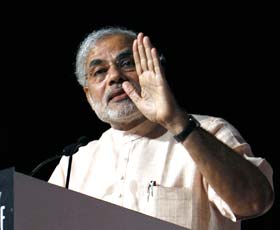
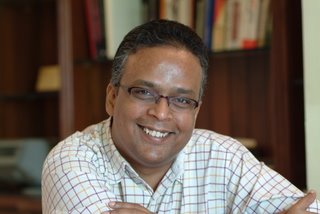
Narendra Modi, Vikram Akula, Yasin Malik and Peter Roebuck were the speakers who made the biggest impression on me. That is saying something since the other speakers included Bill Clinton, Al Gore, L K Advani, Chidambaram, Mukesh Ambani, Adam Gilchrist, Amir Khan, Preity Zinta, Sachin Pilot, Farookh Abdullah, Digvijay Singh, Bishen Bedi, Ashok Amritraj and Craig Venter.
I must also mention in this context that some of the moderators were brilliant too. Aron Purie, Anand Mahindra, Shekhar Kapur and Prabhu Chawla excelled in this role. I have never seen such high quality moderation at any panel discussion before.
Narendra Modi & Yasin Malik (the Kashmir Liberation Front leader who is fighting for an independent
I didn't dare do a similar exercise after Yasin Malik's speech. I did put my foot in my mouth by saying that I was impressed by him to a person who, I later discovered, was a Kashmiri Pandit. This gentleman was already seething and he just let me have it. He called Malik a murderer, a rapist and a terrorist and criticized the India Today people for having him at the conclave. He was not alone. A few people were demonstrating outside the hotel and one person actually entered the hall and shouted to have the event stopped. He was escorted out by the security people.
Mr. Al Gore’s speech was billed as the highlight of the conclave. The turnout for this absolutely amazing. Half the Indian cabinet (including Mr. Chidambaram) were present. All the speakers stayed on to listen to him – this included film stars like Preity Zinta and Amir Khan. All the industrialists came back from their meetings. (I even noticed Mr. & Mrs Adi Godrej, who seemed to have flown in from
In the end, the speech was a little disappointing. I guess it is tough to live up to such hype. Especially when you have just one theme to talk about and everyone has seen the movie where you said it all. Still, he did very well in the Q&A. I noticed that Mr. Aroon Purie only allowed the high and mighty to ask questions of Mr. Gore.
The conclave was exceptional in the wide range of topics that it covered. The theme was “Leadership in the 21st century”. Sessions were ear marked to study leadership issues in communication, ethics, spirituality, sports, entertainment, the environment etc. There was even a youth forum where speakers spoke on what they would do if they could change the world. This is where Vikram Akula, who is
Its tiring sitting in those uncomfortable chairs all day for two and a half days. One eats a lot and doesn’t exercise at all. But in this conference, the mind got good food and good exercise. Thank you India Today for that.
Scam ads.
Two short words that stir up a lot of debate and strong feelings. Clients & competitors snigger at them. Creative people hate the term and fiercely defend the concept. Journalists ask award show organizers their stance on scam ads. Award juries spend more time debating whether an ad was a scam than its intrinsic merits.
Fashion shows.
A ceremony where designers show off clothes that nobody would wear in normal life. Where celebrities, critics, journalists and the public go into raptures about the relative merits and talents of the designers. Where only the most naïve and forthright people question the need for creating those dresses. So why aren’t those clothes called Scam dresses?
Formula 1.
A car race for cars that can’t be driven on normal roads with normal traffic. Where car, tyre, fuel and lubricant manufacturers jostle to create cutting edge products that aren’t for the lay public. Another place which generates a lot of passion and excitement but where nobody talks of scams.
I could go on with examples from other industries and other walks of life. But let’s now address the key question. Why is it that only advertising gets the label of “scam” and why is it that only we talk about it so much?
The answer probably emanates from a misunderstanding about the nature and purpose of creative awards.
Creative awards are meant to recognize work that has pushed the boundaries of communication. Effectiveness awards recognize work that has pushed sales or other results for the client. In the context of cars, Formula 1 races are creative awards, while car rallies are effectiveness awards. Get the difference?
I think juries of creative awards should be looking for unique insights, creative expressions and execution techniques. These insights, expressions and techniques could be demonstrated in the form of scam ads. That’s fine. What is important is their brilliance, their creativity.
Perhaps creative awards should drop the criteria that an entry needs to have been done for a real client and released. Why is that essential? If I have a brilliant insight for selling cars, then I should be allowed to use that insight in an ad that I create for a fictitious car and enter it for awards. If the idea is really great, then I should get an award.
Dropping these two criteria (or real client and release) would release ad agencies from a huge moral dilemma and also save the industry a lot of money. We all know that scam ads get released either at agency expense or by culling favours. Shouldn’t we just abandon this hypocrisy?
The advertising industry doesn’t have much of a R&D budget. We may do the occasional research, but that is usually to get PR for our companies rather than to genuinely unearth new insights. But there is a huge opportunity for turning creative awards into an engine for industry wide R&D.
This is where we can develop path breaking insights, expressions and techniques that would then be used (perhaps in a modified or watered down manner) for normal everyday work. Insisting that path breaking work be released is like asking Albert Einstein the practical uses of the theory of relativity. There are uses, but not all of them are apparent when the theory is first propounded.
Once we make it clear that creative awards do not need to be done for a real client, we are free from the constraints of that brand’s guidelines. We are out into the scary green fields of pure creativity. If we can then create something that makes the whole industry gasp – a show stopper in a fashion show – then we really do deserve all the accolades that we can get.
| |||||||||||||||||||||||||||||||||||||||||||||||||||||||||||||||||||||||||||||||||||||||||||||||||||||||||||||||||||||||||||||||||||||||||
| |||||||||||||||||||||||||||||||||||||||||||||||||||||||||||||||||||||||||||||||||||||||||||||||||||||||||||||||||||||||||||||||||||||||||